Gateway Data Package for routing Internet requests through mesh. More...
#include <gateway.hpp>
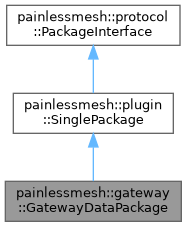
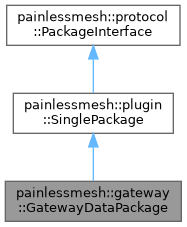
Public Member Functions | |
| GatewayDataPackage () | |
| Default constructor. | |
| GatewayDataPackage (JsonObject jsonObj) | |
| Construct from JSON object. | |
| JsonObject | addTo (JsonObject &&jsonObj) const |
| Serialize to JSON object. | |
| size_t | jsonObjectSize () const |
| Calculate JSON object size for ArduinoJson v6. | |
 Public Member Functions inherited from painlessmesh::plugin::SinglePackage Public Member Functions inherited from painlessmesh::plugin::SinglePackage | |
| SinglePackage (int type) | |
| SinglePackage (JsonObject jsonObj) | |
| JsonObject | addTo (JsonObject &&jsonObj) const |
| Public Member Functions inherited from painlessmesh::protocol::PackageInterface | |
| virtual | ~PackageInterface ()=default |
Static Public Member Functions | |
| static uint32_t | generateMessageId (uint32_t nodeId) |
| Generate a unique message ID. | |
Public Attributes | |
| uint32_t | messageId = 0 |
| Unique message identifier. | |
| uint32_t | originNode = 0 |
| Node ID that originated this message. | |
| uint32_t | timestamp = 0 |
| Creation timestamp. | |
| uint8_t | priority = static_cast<uint8_t>(GatewayPriority::PRIORITY_NORMAL) |
| Message priority (0=CRITICAL, 1=HIGH, 2=NORMAL, 3=LOW) | |
| TSTRING | destination = "" |
| Destination URL or endpoint. | |
| TSTRING | payload = "" |
| Application payload data. | |
| TSTRING | contentType = "application/json" |
| MIME content type. | |
| uint8_t | retryCount = 0 |
| Number of relay attempts. | |
| bool | requiresAck = false |
| Whether acknowledgment is required. | |
| uint32_t | requestNonce = 0 |
| Random value drawn once per sendToInternet() call. | |
| Public Attributes inherited from painlessmesh::plugin::SinglePackage | |
| uint32_t | from = 0 |
| uint32_t | dest = 0 |
| router::Type | routing = router::SINGLE |
| int | type = 0 |
| int | noJsonFields = 4 |
Static Public Attributes | |
| static constexpr int | numPackageFields = 10 |
| Number of additional JSON fields in this package. | |
Detailed Description
Gateway Data Package for routing Internet requests through mesh.
This package enables mesh nodes to send data through a gateway node to the Internet. It provides a standardized format for:
- HTTP requests to external APIs
- MQTT message publishing
- WebSocket communications
- Any other Internet-bound data
MEMORY FOOTPRINT
The GatewayDataPackage structure has an estimated memory footprint of:
- Base fields (from SinglePackage): ~20 bytes
- Fixed fields (messageId, originNode, timestamp, priority, retryCount, requiresAck): ~18 bytes
- TSTRING fields (destination, payload, contentType):
- ESP8266/ESP32 String: ~12 bytes overhead per String + content length
- PC/Test std::string: ~32 bytes overhead per string + content length
- Total estimated minimum: ~74 bytes (ESP) to ~134 bytes (PC/Test)
- With typical content: ~200-500 bytes depending on payload size
For ESP8266 with ~80KB RAM, keep payload under 1KB for safety. For ESP32 with ~320KB RAM, larger payloads are acceptable.
MESSAGE ID GENERATION
Use generateMessageId(nodeId) to create unique message IDs. The ID combines a per-node counter with the node ID to ensure uniqueness across the mesh network.
Example usage:
Type ID: 620 (GATEWAY_DATA) Base class: SinglePackage (routed to specific gateway node)
Constructor & Destructor Documentation
◆ GatewayDataPackage() [1/2]
|
inline |
Default constructor.
Creates a GatewayDataPackage with type ID 620 (GATEWAY_DATA).
◆ GatewayDataPackage() [2/2]
|
inline |
Construct from JSON object.
Deserializes a GatewayDataPackage from a JSON object. Compatible with ArduinoJson v6 and v7.
- Parameters
-
jsonObj JSON object containing package data
Member Function Documentation
◆ addTo()
|
inlinevirtual |
Serialize to JSON object.
Adds all package fields to the provided JSON object.
- Parameters
-
jsonObj JSON object to add fields to
- Returns
- The modified JSON object
Implements painlessmesh::protocol::PackageInterface.
◆ generateMessageId()
|
inlinestatic |
Generate a unique message ID.
Creates a unique message ID by combining a per-node counter with the node ID. This ensures uniqueness across the mesh even if multiple nodes generate IDs simultaneously.
The ID format is:
- Upper 16 bits: Lower 16 bits of node ID
- Lower 16 bits: Incrementing counter (wraps at 65535)
- Note
- This function is not thread-safe. On ESP8266/ESP32, this is acceptable as the main loop is single-threaded. For multi-threaded environments, consider using atomic operations.
- Parameters
-
nodeId The ID of the node generating the message
- Returns
- A unique message ID
◆ jsonObjectSize()
|
inlinevirtual |
Calculate JSON object size for ArduinoJson v6.
Used for buffer allocation when serializing.
- Returns
- Estimated size in bytes
Implements painlessmesh::protocol::PackageInterface.
Member Data Documentation
◆ contentType
| TSTRING painlessmesh::gateway::GatewayDataPackage::contentType = "application/json" |
MIME content type.
Describes the format of the payload. Common values:
- "application/json"
- "text/plain"
- "application/octet-stream"
◆ destination
| TSTRING painlessmesh::gateway::GatewayDataPackage::destination = "" |
Destination URL or endpoint.
The Internet destination for this data. Examples:
- "https://api.example.com/sensor"
- "mqtt://broker.example.com/topic"
- "wss://ws.example.com/stream"
◆ messageId
| uint32_t painlessmesh::gateway::GatewayDataPackage::messageId = 0 |
Unique message identifier.
Generated using generateMessageId() to ensure uniqueness across the mesh. Used for tracking, acknowledgment, and deduplication.
◆ numPackageFields
|
staticconstexpr |
Number of additional JSON fields in this package.
Used for jsonObjectSize() calculation in ArduinoJson v6. Count: msgId, origin, ts, prio, dest_url, payload, content, retry, ack, nonce = 10 fields
◆ originNode
| uint32_t painlessmesh::gateway::GatewayDataPackage::originNode = 0 |
Node ID that originated this message.
The node that created the message, which may differ from the 'from' field during relay operations.
◆ payload
| TSTRING painlessmesh::gateway::GatewayDataPackage::payload = "" |
Application payload data.
The actual data to send to the destination. Format depends on contentType (JSON, binary, etc.).
◆ priority
| uint8_t painlessmesh::gateway::GatewayDataPackage::priority = static_cast<uint8_t>(GatewayPriority::PRIORITY_NORMAL) |
Message priority (0=CRITICAL, 1=HIGH, 2=NORMAL, 3=LOW)
Determines processing order at the gateway. Use GatewayPriority enum for type-safe values.
◆ requestNonce
| uint32_t painlessmesh::gateway::GatewayDataPackage::requestNonce = 0 |
Random value drawn once per sendToInternet() call.
The same on every attempt at that call, and part of its X-Request-Id and Idempotency-Key (requestIdFor()). messageId alone repeats: its counter is 16 bits, so a node that sends more than 65,535 requests in one boot reissues old ids, and a service that remembers keys would drop the new request as a repeat. 0 from a node that predates the field. JSON key "nonce", omitted when 0.
◆ requiresAck
| bool painlessmesh::gateway::GatewayDataPackage::requiresAck = false |
Whether acknowledgment is required.
When true, the gateway should send a response back confirming successful delivery to the Internet destination.
◆ retryCount
| uint8_t painlessmesh::gateway::GatewayDataPackage::retryCount = 0 |
Number of relay attempts.
Incremented each time the message is relayed. Can be used for hop counting and loop detection.
◆ timestamp
| uint32_t painlessmesh::gateway::GatewayDataPackage::timestamp = 0 |
Creation timestamp.
Mesh time when the message was created. Used for TTL calculations and ordering.
The documentation for this class was generated from the following file:
- src/painlessmesh/gateway.hpp